Tuesday, April 19, 2016

The Sad Saga of the Pittsburgh Steelers Secondary

This week, Cortez Allen was released by the Pittsburgh Steelers only two years into a five year deal worth $26 million, half of it fully guaranteed, winning him the Donnell Woolford / Deuce Staley Memorial Clipboard of Uselessness. It's rare for Pittsburgh to so quickly admit a fuckup of this magnitude, but it's possible that the Steelers have finally realized their long history of terrible personnel moves and inability to draft top talent at one of the most important positions on the gridiron. Despite fielding some of the best defenses in the NFL for much of the last 20 years, not one Steeler corner has even managed to achieve the dubious honor of a Pro Bowl berth since Rod Woodson's last season with the team in 1996, despite the Pro Bowl voting's domination by idiot fans and the Steelers' immense popularity.

My brother and I decided to go through the litany of terrible DBs the Steelers have trotted out over the years, and it took nearly an hour. The back-and-forth texts seemed as endless as the Catalog of Ships in Homer's "Illiad," or the Book of Chronicles in the Old Testament. Here's my list of the ten worst Pittsburgh Steeler cornerbacks of the last twenty years. I've confined the scorn to starters and players drafted in the 3rd round or higher since 1997.

1. Donnell Woolford (1997-1998): Woolford was brought over from the Bears to replace Rod Woodson in 1997. He was considered to be a marquis free agent signing for the team who'd been a Probowler as recently as 1993, but he'd unfortunately decided to retire after the 1996 season and not inform his new employers. He flat out could not play, and washed out almost immediately. Despite this, the Carolina Panthers - at this time, under Dom Capers' mismanagement, a retirement home for Blitzburgh alumni from the early 90s - picked him up and gave him a check for a couple of years. I'm sure Donnell Woolford mentions Capers in his prayers nightly.

2. Dewayne Washington (1998-2003):
Carl Pickens, defining the career of Dewaye Washington in 1998.
His was a tale of sorrow. Shortly after Washington was signed in the 1998 offseason to fill the colossal hole Donnell Woolford had sucked open in the secondary, a pair of Viking fans came to the video store where I worked. I was probably wearing my Kordell Stewart jersey (to be later burned in the front yard at some point in 1999), so the guy pipes up with, "Hey you guys just signed Dewayne Washington I heard," with a knowing grin. At the time, the Pittsburgh press was abuzz with the new signing and largely complimentary. "He's ok, but he just always seems to be the guy getting burned at the worst possible times." Prophetic words.

Dewayne Washington would become one of the Steelers I hated most. It wasn't necessarily his fault that his tenure happened to coincide with one of the most interminably mediocre eras in modern Steeler football, but he definitely did his part to define the futility of those years. The defining Dewayne moment for me was when hated former Steeler Super Bowl QB Neil O'Donnell, then with the equally hated Bengals, burned poor Dewayne with a fake spike game winning TD pass to Carl Pickens, who then talked shit to Dewayne as he lay humiliated on the turf. In an era when it was still legal to maul receivers during their routes in man-to-man coverage, Dewayne was the routinely posterized bitch of many a big receiver of the era.

3. Chad Scott (1997-2004): Scott was a first round pick who became just a guy. He wasn't bad, but he wasn't a standout. If the best thing you can say about a corner is "good tackler," he basically sucks. That's about the best thing I can say about Chad Scott. Everyone caught the ball on him, but hey he could make sure they didn't run very far afterwards. That and the Steelers' horrible draft picks at his position over the years (see Poteat, Hank below) meant that Chad Scott's sorry ass kept getting the starting job by simply showing up for work every autumn. He ended up joining the Patriots in 2005 and 2006 after the Steelers let him walk, and probably not coincidentally they were two of the rare post-2001 Patriots seasons in which Tom Brady didn't at least make it to a Super Bowl.

4. Hank Poteat (2000-2003): Poteat played well for Pitt. This meant that yinzer fans in 2000 thought he was going to be the next Rod Woodson - I actually read this in one column at the time. This is probably also what induced the Steelers, following two boring years of hideous failure during the First Kordell Stewart Dark Age, to draft him in the 3rd round: let's give the fans something to cheer about after they're done booing another Kordell Stewart three-and-out. Hank Poteat was shit in human form. He was also the beginning of about 15 years of terrible 2nd and 3rd round draft picks in the secondary and was gone by 2003 after posting a whopping 28 tackles in three years. He must have had a great agent, because he managed to occupy the lower echelons of the rosters of four other NFL teams for almost a decade before finally reaching the end of the road with the Cleveland Browns in 2011. In over a decade of work, Hank Poteat had four interceptions.

5. Ike Taylor (2003-2014):
No explanation needed.
I hate Ike Taylor. Like Chad Scott before him, Taylor managed to triumph in camp over incredibly weak draft picks on an annual basis and assemble what has to be one of the longest careers as a starter by a bad corner in the history of the league. Expectations, by the time he arrived, were very low. The Steelers had been trotting out the likes of the four guys above for almost a decade. He looked like just another wasted mid-round Steeler cornerback draft pick for his first two years, but in year three, 2005, he managed to crack the starting lineup and hold down the position for the entire year, even playing well in the playoffs and in the Super Bowl. "HOLY FUCKING SHIT," thought the entire Pittsburgh front office, "WE FOUND ONE! HE IS THE LIGHT AND THE WAY!" so they gave Ike a massive deal to start the 2006 season, making him the highest paid corner in the history of the team.

Ike rewarded that confidence by immediately turning into total garbage in 2006, eventually losing his job to Deshea Townsend in week 10, and he was an up-and-down player ever thereafter. His biggest problem was possibly the worst hands in the NFL. You could float a ball directly into Ike's waiting arms with no one anywhere near him, and he would find a way to drop it. I remember one training camp when he carried around one of those cup-and-ball toys in the pathetic and ultimately vain hope of developing better hand-eye coordination. He worked with the receivers in camp in 2008 for the same reason, which must have been really hilarious to watch, but to no avail. In fact, just about every off season while Ike Taylor was with the Steelers you could find some sad story about how he was doing something stupid in the hope of somehow learning to close his rocklike hands around a football on the field, but all for naught: Ike Taylor could not catch footballs. In 12 seasons as a starter, he managed only 19 interceptions.

Despite assembling a resume which showed that the only thing he could do consistently was drop easily catchable interceptions, the Steelers AGAIN rewarded Taylor with a massive contract - 4 years, $28 million - before the 2011 season. Ike Taylor spent most of the year showing that this had been a very bad idea, culminating in one of the most humiliating, disgustingly embarrassing defensive lapses ever committed by a member of the team: getting updated by Tim Tebow in the playoffs. The ignominy that his performance brought down on Steeler Nation cannot ever be forgiven. He will be forever remembered, flailing his arms uselessly, terribly out of position, as Tim Tebow lofted the game winning pass over his head. MOTHERFUCK Ike Taylor.

6. Ricardo Colclough (2004-2008): Colclough is one of four defensive backs the Steelers drafted in the 2nd or 3rd rounds from 1999 to 2011 to have played fewer four or fewer years for the team. Drafted in the 2nd round, Colclough was an immediately obvious bust.

7. Bryant McFadden (2005-2008, 2010-2011):
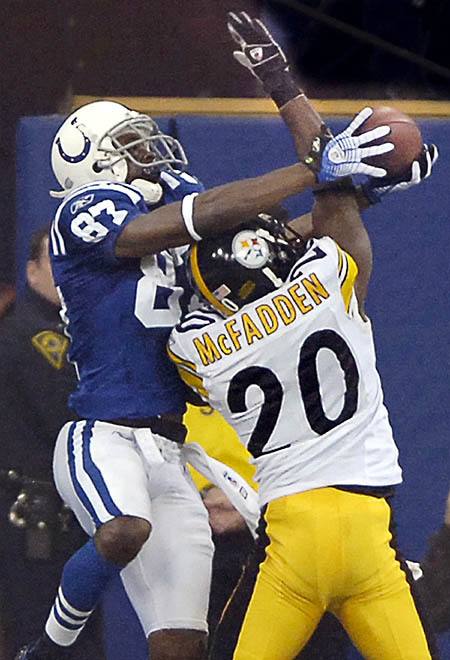
Thanks for the memory.
One of very few Steelers to be brought back from exile in Arizona (the other being fellow adequate veteran cornerback Willie Gay), retirement home for Pittsburgh players good and bad since they started hiring all of our former coordinators as head coaches. McFadden was the Steelers 2nd round pick the year after Colclough, and while he wasn't a complete bust like Colclough, he wasn't a reliable starter even at nickelback. I'll give him credit for having one great play in his career: the breakup on Manning's pass to Reggie Wayne at the end of the Steelers' playoff victory over the Colts in 2005. It's not well remembered, but if McFadden doesn't make that play, the Steelers don't go on to beat the Seahawks in Super Bowl XL. Aaron Rodgers later made him his bitch in the playoffs both when he was with Arizona in 2009 and in the Steelers' last Super Bowl appearance in 2010, and that was about it for McFadden. 

8. Curtis Brown (2011-2014): Brown was another relatively high complete bust pick, taken in the third round in 2011. He managed 1 interception in his 3 year, totally meaningless career.

9. Cortez Allen (2011-2015): After committing the colossal gaffe of letting the ONLY decent cornerback drafted in the 21st century, 2009 3rd round pick Keenan Lewis, walk out the door and join the Saints in 2011, the Steelers doubled down on their mistake by panicking and giving Cortez Allen a huge contract in 2014 after he'd started a grand total of 11 games in his previous three years. The Steelers believed he'd been ready to take the next step, and they were right, but that next step was onto an injury cart, where Allen would spend the remainder of his career in Pittsburgh.

10. Willie Gay (2007-2011, 2013-present): The saddest thing you can say about the Pittsburgh Steelers' current secondary is that Willie Gay anchored it at the age of 30. He was BY FAR the best corner on the team, albeit a team that started guys named Antwan Blake and Ross Cockrell at the position at various times during the year. Gay, like Ike Taylor, was long the beneficiary of the colossal draft failures at corner over the last 20 years, which allowed a merely serviceable veteran to stand out like a man among boys. It's shameful that the team is bringing him back at the age of 31 due to a lack of better options. Willie Gay starting in 2015 was unmistakable evidence that the Steelers secondary sucked. The fact that they decided to give Gay a three year deal last month at age 31 means that they're resigned to continuing to suck for the foreseeable future.

Friday, March 25, 2016

Mmm Bop

Going through some content mill website yesterday I came across something like,
"This will make you feel really old! Mmm Bop by Hanson turned 20 today!" The story was accompanied by a picture of Hanson today, looking as rosy cheeked, cocksure and wholesome as ever.

Actually, seeing this didn't make me feel old. Feeling old happens when you start to find yourself surrounded by adults born when you were in high school. What it did do was remind me of what this awful fucking song meant to me when it took America by storm in 1997, and when it unfortunately re-entered my life on one fateful evening years later.

When I was in high school in the early 90s, the airwaves were dominated by heroin-fueled grunge rock. It had an edge to it, and it felt legitimate and real. It was great. My dad even started buying rock albums again. Then Cobain died in 1994, and it seemed like he took the music with him. It wasn't really his death that did it, but a sequence of events in the mid-90s followed on his suicide that largely ruined rock music forever. Pearl Jam took on Ticketmaster and lost, and then decided to pick up their toys and go home, which for them meant disappearing deep inside their own asses. Clinton de-regulated radio in 1996, killing independent FM stations nationally and giving rise to the monster that is Clear Channel overnight. Douchebag A/R guys who had been chomping at the bit for years to push manufactured commercial garbage again started filling our ears with crap like Ace of Bass.

And then came Hanson, to announce that it was all over, and that popular music (at least white pop music) was going to suck from now on. For months, you could not escape these saccharine-sweet Tulsa Aryan Jackson Five wannabes. I consider myself lucky to have survived 1997 with my sanity. Hanson's Operation Rolling Thunder-esque carpet bombing of the national musical consciousness paved the way for its wholesale surrender to the likes of Backstreet and N'Sync a few short years later.

None of that is why hearing Mmm Bop fills me with unutterable loathing to this day. There's a very personal reason for that.

In 1999, I went to Switzerland, my first ever trip abroad alone and my first trip to Europe. I was 22 years old, hopeful and expectant. When you come from a hick meth lab of a town whose sole claim to fame is what is alleged to be the world's tallest barber pole, you tend to put the Old World on a pedestal. For the first time in my life I felt like I was where I truly belonged: surrounded by cosmopolitan, interesting, well-educated people in a place steeped in history. Then one night, I was at a party in an ancient guild hall under Bern when the DJ put on Mmm Bop. I groaned aloud, expecting everyone to join me in getting him to put on another record. It was obvious to me that no thinking human being could possibly want to hear Mmm Bop ever again.

To my horror, all those around me - these people I wanted so badly to impress - started to smile and get up to go and dance. To Mmm Bop, in 1999. I was aghast, and actually angry. I felt betrayed. Having had a few, I actually tried to stop some of them from dancing. They angrily brushed past me and took the floor, dancing horribly, as Europeans do, loving every second of the song I hated so, so much. I sank back into my seat and held my head in my hands. Mmm Bop had come back from the grave to crush another part of my soul, and I was completely helpless.

That's why, to this day, whenever I hear Hanson, I'm not nostalgic. I'm not annoyed. I'm upset. Somehow, this shitty fucking song managed to alienate me from two cultures. It has actually harmed me.

And now it's stuck in my fucking head AGAIN.

Wednesday, February 24, 2016

The Incredibly Strange Films of Herschell Gordon Lewis


Movies have always been a huge part of who I am. My parents are both film buffs and my grandfather's substitute for human interaction when I was a kid was putting on a film from his humongous collection of VHS tapes. I jockeyed a counter at both an independent movie theater and an independent video store in my first two part-time jobs. I've seen more movies than nearly anyone else I know across the full spectrum of genres, eras, countries and styles. I say this not as any sort of brag but because the filmmaker I'm about to fete in this post is a place you reach only after you trudge down all of the well-worn paths. He's an alley that you notice while you're on your way to some more respectable destination; a garbage-strewn, malodorous alley. Something impels you to investigate despite the smell - or because of it.

Having somehow seen eight of Herschell Gordon Lewis' films, I feel like I'm ready to respond. I found him in the most innocuous of ways: a fan-made list of horror films on the internet. I'd already done all the usual 1980s slasher fare, so I was digging deeper, and the title of Lewis' first and most well-known film jumped off the screen at me: Blood Feast.

Fuad Ramses, Blood Feast


Blood Feast (1963) is a good place to begin the HGL experience. All the elements of his best splatter flicks are here: buckets of blood and gore, bold color photography which stands out amid often shocking technical improficiency, and bad acting by a collection of "actors" who look like, and probably were, scum willing to work for next to nothing. 

This is a movie that knows that it needs to function only on a very crude level to be effective, like a stone axe fashioned by an early hominid. Inspired by the cheap faux ancient Egyptian decor of the fleabag Miami hotel Lewis had been staying in while working on a nudie film, Blood Feast had no script. That's not a humorous exaggeration to illustrate how bad the script was: it literally had no script and was freestyled by cast and crew on a daily basis. I won't go into a long exposition of the plot, which you can find elsewhere. I'll just say that despite transparently existing solely to set up the gore, the plot is actually fairly engaging.

Notice what I just did? This is something that begins happening to you when you repeatedly subject yourself to some of the worst-made films of all time: you begin apologizing for deficiencies and emphasizing dubious merits. Your perceptions and standards begin to warp as you gaze into the abyss, for the abyss gazes back. You're not here for the highest quality cinematic experience you can get. You're here because despite their obvious shortcomings, these movies are surprising. Lewis' films are made in ways that run counter to nearly every reasonable expectation.

Firstly, the gore scenes in Blood Feast are some of the more revolting Lewis ever put on screen. It's all pig guts, blood and meat from a butcher shop, but that makes it no less effective. This isn't a Hollywood horror film, where you nearly always sense a certain embarrassment on the part of the filmmaker where gore is employed. The blood is fleeting; blink and you'll miss it most of the time. Lewis has exactly the opposite tendency. His camera sits there, static and unflinching, producing something reminiscent of crime scene or autopsy footage. Hands reach into the frame, play with the gore, and slowly withdraw. It's near-pornographic, it's crudely done, but that doesn't stop it from being viscerally disgusting and strangely compelling.

Connie Mason, Playboy Magazine's Miss June 1963, ladies and gentlemen

Blood Feast was a smash hit, to the great surprise of everyone involved. Galvanized by success, Lewis set out to do something special for his second film, Two Thousand Maniacs (1964) - always a dangerous goal for a filmmaker. This more self-conscious work isn't as effective as Blood Feast. Think Brigadoon, only with murderous, deranged hillbilly Confederates intent on avenging the Civil War. Maniacs unwittingly pioneered the scary hillbilly trope that reached its apex with Deliverance almost a decade later. Regrettably, the bold primaries of Blood Feast's claustrophobic gore-splattered interiors have given way to a lot of mundane, washed-out looking exterior shots. The camera doesn't linger over Lewis' travesties nearly long enough to achieve the desired effect.

Maniacs is where you begin to notice one of Lewis' calling cards: everything seems to go on more than a couple beats too long. Enter the unforgettably torturous bluegrass theme song, written by Lewis himself, played by a band at the beginning of the film in its entirety. In fact, like John Carpenter later, Lewis composed all of the music for all of his films, and it's generally strange stuff. But where Carpenter's spartan and effective synth scores show real talent, Lewis' are alarming. They generally sound like what they are: a non-musician's half-baked notion of what a score should sound like. They're weird, ad hoc facsimiles, copies of copies. Yet somehow these god awful scores only add to his films' pervasive oddness.

The Man-Eaters get down with their studs, She-Devils on Wheels


After spending most of the 1960s churning out cheap entries in nearly every genre imaginable, including a children's musical, Lewis made two very interesting films: She-Devils on Wheels (1968) and The Wizard of Gore (1970). In She-Devils, we have Lewis, a director responsible for all manner of crass, on-screen exploitation of women, helming a feminist biker film with a screenplay written by a woman - his frequent co-conspirator, Allison Louise Downe. Biker films of the late 1960s are as a genre notorious for their sexual violence, but this biker gang is all women - the Man-Eaters - who consciously devalue and sexually objectify men. The Man-Eaters hold a race among themselves to determine who gets the first pick from their stable of kept men - their "stud farm" - which is populated by a collection of scuzzy miscreants repulsive even by the standards of a Lewis film.  Lewis brings his signature bloody touch as well, including a truly glorious decapitation. Is there at times shockingly bad camera work? You bet. Crap acting? Absolutely. Still a remarkably fun film to watch and a clever upending of classic biker cinema.

Montag the Magnificent, The Wizard of Gore himself


The Wizard of Gore (1970), made very near the end of Lewis' film making career, is his most ambitious splatter film. It opens with an (unsurprisingly) overlong harangue by the wizard himself, Montag the Magnificent, on the nature of fantasy and reality. The gore is indoors, rank, and brutal and the prosthetics are hilarious - the scenes of hypnotic murder are a lot of fun to watch, as always.

What sets this film apart among Lewis' other gore films, however, is the surprisingly engaging plot, which is trying to do much more than simply set the stage for the blood and guts. Without giving anything away, the film brings Philip K. Dick's reality-bending novels to mind. The off-kilter nature of Lewis' films is on full display from the moment this one begins. If Lewis should be remembered for any single film among his strange oeuvre, this is it.


Tuesday, January 26, 2016

The 2016 election as of January 26, 2016

"Prediction is very difficult, especially if it's about the future."

- Niels Bohr

That aside, I'm prepared to say today that the president will be either Hillary Clinton or Michael Bloomberg.


The reigning king named no successor on his deathbed, making civil war inevitable among an even more repellent field than is ordinarily the case. Pressing the claims of the White Rose, an unfathomably crude, overtly racist P.T. Barnum, willing to cheerfully plumb depths of political discourse so abyssal that he will soon need a bathysphere. Lurking in the shadows, a Torquemada who wants an ideological cleansing and a crusade feared no less by his own party's greybeards than by his would-be opponents.

For the Red Rose, preparations for the coronation of female Nixon - without his charisma or political acumen - continue amid growing concern. Despite every conceivable advantage, her mere presence has animated with real life the joke candidacy of an ossified, neckless scowl knowingly hawking an agenda preconditioned on a "political revolution," a distortion of American political reality so absurd that Aaron Sorkin would struggle not to laugh. Hillary's unmatched reptilian charmlessness has allowed a terrifying prospect to crystallize into view: Trump v. Sanders. This would be an apocalypse, because the only human who would lose a national election to a figure as appalling and ridiculous as Donald J. Trump is Bernie Sanders.

Whispers of plots for world domination by NYC's Bond villain ex-mayor are hardly surprising given the circumstances. He'll watch and wait until early March, and if Sanders has real momentum after Nevada and Trump is sewing up the GOP, he'll intervene and likely win the presidency. If Hillary manages to fend off the children's crusade on her left, he'll stay out. Bloomberg's base would be those Democrats too conservative to vote for a communist and those Republicans too sane to vote for a racist clown. I believe it's a coalition that would be large enough to win against the rump Democrat left and the Tea Party. We'd be left with a serial misogynist whose greatest legacy is the transformation of NYC into a gentrified, racist police state. Although preferable to a world in which Trump has nuclear weapons at his disposal, the naked purchase of the presidency by a fascist oligarch would complete America's transformation into a plutocracy in both name and fact.

Sunday, January 24, 2016


"Beasts of No Nation" was a much better film than I was expecting although not particularly groundbreaking. I didn't know going in that it was the second feature film directed by Cary Fukugawa, whose "Jayne Eyre" (2011), with Mia Wasikowska and Fassbender, I liked a lot. It's photographed beautifully if conventionally. As with all child soldier war films, a lush and happy pre-war childhood is used as a counterpoint to the sickening brutality of the later conflict. However, like a lot of current cinema, TV and music (e.g. Mr. Robot, Star Wars Episode VII), it's also at least in part shamelessly and unapologetically derivative.

I'm referring to the sequence in which Agu and the rest of his militia take "gun juice" - some kind of unnamed hallucinogenic drug - and sack a village. It's one of the most important parts of the film, and it's colorized to deliberately bring to mind Richard Mosse's classic Kodak Aerochrome infrared film documentary on the Congolese civil war, "The Enclave," and his still work across a variety of African conflicts using the same technique. It's unfortunate and dishonest of Fukugawa to not acknowledge the extent to which the central, violent sequence of his film is derived from Mosse's work. Presumably he's waiting for Mosse to file a copyright lawsuit before disgorging any credit, much as Drake did with James Turrell's after jacking his light installations in his Hotline Bling video. I really liked this film, but this lazy copying we're seeing across the arts has got to stop. This is probably the most visually memorable part of the film and it's straight up ripped off.

That aside, there is great work here. Attah's performance is one of the best ever by a child actor and Elba is brilliant as always. There are great supporting turns here too, by Francis Weddey as Agu's older brother and by Emmanuel Nii Adom Quaye as Strika, to name a couple. It deserves consideration among the best child soldier films I've seen. I'd like to revisit a few of them here to put "Beasts" in its proper context: Die Brucke ("The Bridge," West Germany, 1959), Ivanovo Detstvo ("Ivan's Childhood," USSR, 1962) and Idi i Smotri ("Come and See," USSR, 1985).

The Bridge, directed by Bernhard Wicki, probably best known for directing the German sequences in "The Longest Day," is very good. The biggest flaw here is that the necessary establishing work of showing the pre-war lives of the characters goes on far too long in this film.

Die Brucke (1959)
A good hour is spent reminding us that the characters are children via much not terribly well-acted domestic melodrama before the battle is joined. Once it is, it's very well filmed. It's also the most similar to "Beasts of No Nation" thematically because the battle the boys find themselves in is as completely pointless as their cause is unjust.

Contrast this with the two Soviet films featuring child soldiers during the Second World War, "Ivan's Childhood" and "Come and See." In these films, the children have no choice but to fight; their enemy, the Nazis, is so pitiless and inhuman that their only other option is death. As such we don't get any rumination on the morality of the boys' casus belli. However, as "Ivan's Childhood" is helmed by one of the greatest filmmakers of all time in Tarkovsky and "Come and See" by a very good one in Klimov, we also don't get simplistic jingoism.

Ivan's Childhood (1962)


Tarkovsky's genius is evident from the first moments of "Ivan's Childhood," which find Ivan dreaming of the happy days before the War, floating through the treetops of his bucolic country home, while he's actually hiding from the Germans in an abandoned building. Child soldier war films need this kind of establishing sequence, but Tarkovsky's is the most skilled and probably the shortest. He doesn't overdo it; he tells it in these dream-like flashbacks that really have the visual power of beautiful memories because, as you would expect from Tarkovsky, the film is shot with staggering power. There are shots in this film that made me gasp, they were so astoundingly gorgeous. The film does become unnecessarily sentimental in the end which cuts into its overall impact, but as a work of original visual photographic and cinematic genius, this is the best film on this list.

Elem Klimov's final film, "Come and See," hits the hardest of all of these movies. It's said to have inspired Spielberg's "Schindler's List," but Spielberg is too much of a wimp to be this brutal for almost 2 and a half hours. Klimov pulled then 15 year old Alexei Kravchenko out of school to play the lead - something only a Soviet director could do - and put him through such an emotional and physical wringer that he was physically transformed by the experience from an apple-cheeked kid to an androgynous, hollow-eyed wraith.
Before
After
In one scene, Klimov had live machine gun rounds fired just a few feet over this kid's head. An entire forest was dynamited around him. His hair turned grey in real life. The brutality of the German onslaught in Belorus is depicted in unflinching horror, a truly shocking miasma of violence, torture and death that even left me feeling wrung out. Klimov himself, and many others who had actually lived through the events, said that he had to water it down because if he'd shown it as it actually had been, no one would have been able to watch it. "Come and See" is Klimov's epic mic drop. He never made another film, and he didn't have to.